

How to Build a Lead-Generating Website for Your Business

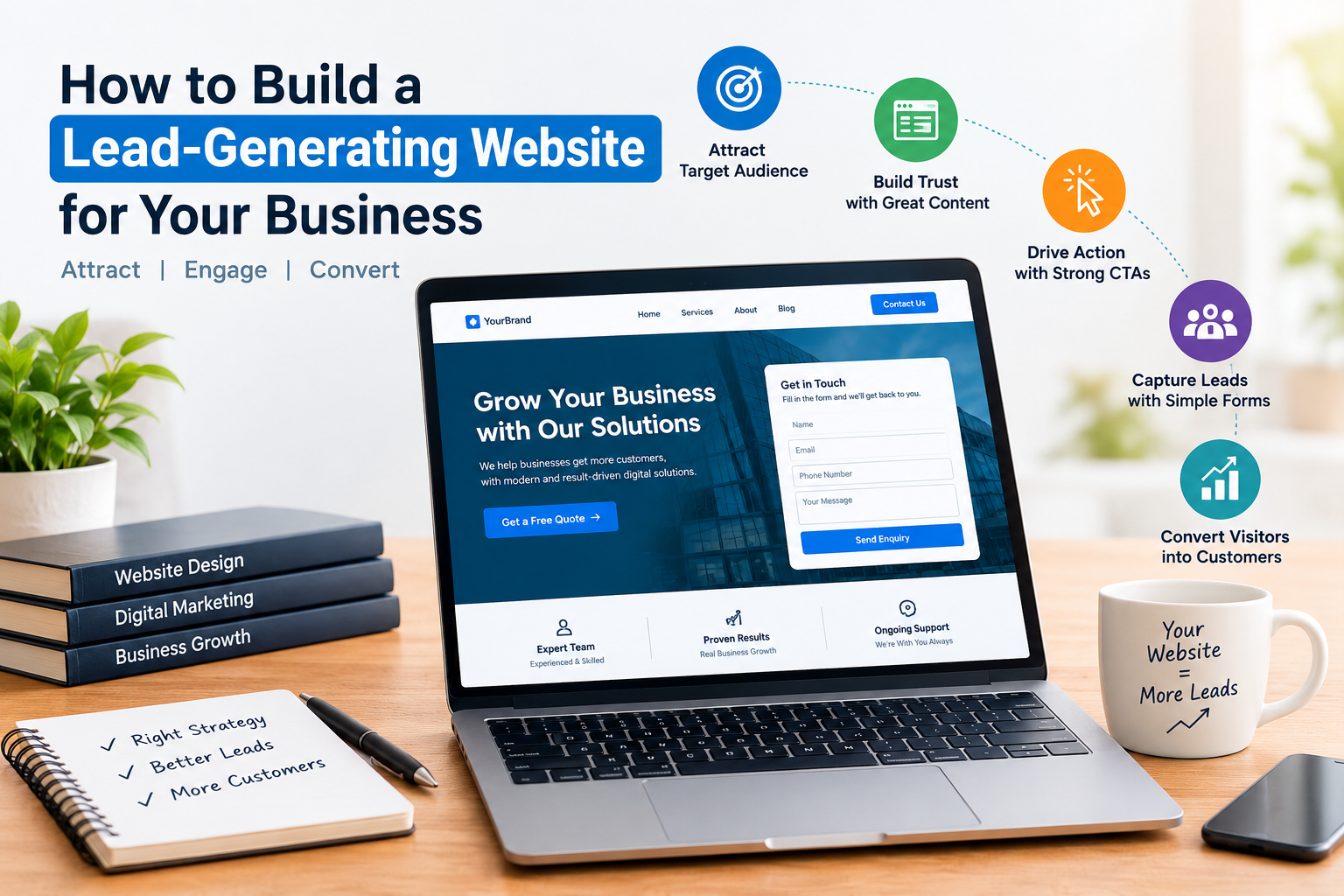
A website is more than just an online presence for your business. When designed strategically, it can become a powerful tool for attracting visitors, building trust, and converting potential customers into leads.
However, simply creating a website does not guarantee leads. Your website needs clear messaging, user-friendly navigation, compelling calls-to-action, optimized landing pages, fast loading speeds, and valuable content that addresses your audience's needs.
In this guide, we will explore how to build a lead-generating website for your business and the key elements that can help turn website visitors into potential customers.
Table of Contents
- What Is a Lead-Generating Website?
- Why Does Your Business Need a Lead-Generating Website?
- Define Your Target Audience
- Create a Clear Value Proposition
- Build a Simple and Professional Website
- Create Strong Calls-to-Action
- Optimize Your Contact and Lead Forms
- Create High-Quality Landing Pages
- Publish SEO-Friendly Content
- Build Trust With Social Proof
- Optimize Your Website for Mobile
- Improve Website Loading Speed
- Use Analytics and Track Conversions
- Optimize Your Website for Local SEO
- Common Website Lead Generation Mistakes
- Final Thoughts
1. What Is a Lead-Generating Website?
A lead-generating website is a website designed to encourage visitors to take a specific action, such as filling out a contact form, requesting a quotation, booking a consultation, making a phone call, or sending an enquiry.
Unlike a basic informational website, a lead-generation website focuses on converting website visitors into potential customers.
For example, a service-based business can use its website to collect:
- Name and contact details
- Email addresses
- Phone numbers
- Service enquiries
- Quote requests
- Consultation bookings
The goal is to make it easy for interested visitors to take the next step.
2. Why Does Your Business Need a Lead-Generating Website?
Customers often search online before contacting a business. Your website can be the first place where a potential customer learns about your products or services.
A properly optimized website can help your business:
- Generate enquiries 24/7
- Increase online visibility
- Build credibility and trust
- Attract organic search traffic
- Showcase products and services
- Collect customer information
- Support digital marketing campaigns
- Reduce dependence on traditional advertising
Your website should not simply tell visitors who you are. It should clearly explain how you can solve their problem and what they should do next.
3. Define Your Target Audience
Before designing your website, understand who you want to attract.
Ask questions such as:
- Who are your ideal customers?
- What problems are they trying to solve?
- What services are they looking for?
- What questions do they commonly ask?
- What makes them choose one business over another?
Understanding your audience helps you create relevant website content, offers, images, and calls-to-action.
For example, an interior design company may target homeowners looking for complete home interiors. Its website should focus on services, designs, pricing information, project examples, customer reviews, and consultation enquiries.
4. Create a Clear Value Proposition
Visitors should understand what your business offers within a few seconds of landing on your homepage.
Your hero section should clearly communicate:
What you offer + Who you help + Why customers should contact you
For example:
Professional Website Development for Growing Businesses
Build a fast, mobile-friendly website designed to attract visitors and generate quality enquiries.
Avoid complicated statements and industry jargon. Keep your message simple and customer-focused.
5. Build a Simple and Professional Website
A professional design helps create a positive first impression. But good design is not only about appearance—it should also make the website easy to use.
Important website elements include:
- Clear navigation
- Easy-to-read content
- Professional images
- Consistent branding
- Visible contact information
- Clear service pages
- Strong CTAs
- Mobile-friendly design
- Fast-loading pages
Your website visitors should be able to find important information without having to search through multiple pages.
6. Create Strong Calls-to-Action
A Call-to-Action (CTA) tells visitors what to do next.
Instead of generic buttons such as “Click Here,” use action-oriented CTAs such as:
- Get a Free Quote
- Request a Consultation
- Book a Demo
- Contact Us Today
- Get Started
- Request Pricing
- Talk to an Expert
Place CTAs strategically throughout your website, especially on service pages and landing pages.
7. Optimize Your Contact and Lead Forms
A lead form is one of the most important elements of a lead-generating website.
Keep forms simple. Ask only for information that you actually need.
For example:
Name:
Phone Number:
Email:
Service Required:
Message:
A long form can discourage visitors from completing it. For many businesses, starting with a short form and collecting additional information later can create a smoother user experience.
8. Create High-Quality Landing Pages
Landing pages are designed around a specific marketing objective.
For example, if you are running a Google Ads campaign for website development, instead of sending visitors to your general homepage, you could create a dedicated landing page for:
Website Development Services in Bangalore
A strong landing page should include:
- Clear headline
- Relevant service information
- Benefits
- Supporting images
- Customer testimonials
- Trust signals
- FAQ section
- Strong CTA
- Simple lead form
The landing page should match the message used in your advertisement or marketing campaign.
9. Publish SEO-Friendly Content
SEO can help your website attract people who are actively searching for your products or services.
Create useful content around questions and keywords your customers search for.
For example:
- How much does website development cost?
- How to choose a web development company?
- Why does your business need a website?
- How can a website generate leads?
- Website design trends for businesses
Use your target keywords naturally in:
- Page titles
- Headings
- Introduction
- Body content
- Image alt text
- Meta descriptions
- URLs
Avoid keyword stuffing. Write primarily for people while making your content easy for search engines to understand.
10. Build Trust With Social Proof
Visitors may hesitate to submit their information if they are unfamiliar with your business.
Build trust by displaying relevant social proof, such as:
- Customer testimonials
- Google reviews
- Case studies
- Client logos
- Project portfolios
- Certifications
- Awards
- Business experience
For example:
“See How We Helped Businesses Improve Their Online Presence.”
Case studies can be particularly useful because they demonstrate real-world results and explain how your business solved a customer's problem.
11. Optimize Your Website for Mobile
A large percentage of website visitors use smartphones. A website that works well on desktop but performs poorly on mobile can lose potential leads.
Make sure your website has:
- Responsive design
- Easy-to-read text
- Mobile-friendly buttons
- Simple navigation
- Fast loading
- Easy-to-complete forms
- Click-to-call functionality
Test your important pages on different screen sizes before launching the website.
12. Improve Website Loading Speed
Website speed can influence user experience and conversions. If a page takes too long to load, visitors may leave before seeing your offer.
To improve performance:
- Compress images
- Use modern image formats where appropriate
- Reduce unnecessary scripts
- Enable caching
- Optimize CSS and JavaScript
- Use reliable hosting
- Consider a CDN for suitable websites
Regularly test your website performance and identify pages that need improvement.
13. Use Analytics and Track Conversions
Launching your website is only the beginning. You should monitor how visitors interact with it.
Useful metrics include:
- Website traffic
- Traffic sources
- Landing page visits
- Form submissions
- Phone clicks
- Conversion rate
- Bounce/engagement metrics
- Top-performing pages
Tools such as Google Analytics and Google Search Console can help you understand website traffic and search performance.
Conversion tracking can also help you identify which pages and marketing channels generate enquiries.
14. Optimize Your Website for Local SEO
If your business serves a specific location, local SEO can help potential customers discover your business when searching for nearby services.
For example:
“Digital Marketing Agency in Bangalore”
Local SEO activities can include:
- Optimizing your Google Business Profile
- Adding your business location to relevant pages
- Creating location-specific service pages
- Maintaining consistent business information
- Collecting genuine customer reviews
- Creating locally relevant content
Make sure location-based content is useful and natural rather than simply repeating city names throughout the page.
15. Common Website Lead Generation Mistakes
Many businesses have websites but fail to generate consistent enquiries because of avoidable problems.
Common mistakes include:
1. No clear CTA
Visitors don't know what action to take.
2. Too much information
Large blocks of text can make important information difficult to find.
3. Poor mobile experience
Visitors may leave if the website is difficult to use on smartphones.
4. Slow loading pages
Performance problems can negatively affect user experience.
5. Complicated forms
Asking for too much information can reduce form completions.
6. Weak website copy
If visitors don't understand your value quickly, they may leave.
7. No trust signals
Testimonials, reviews, case studies, and portfolios can help establish credibility.
8. No conversion tracking
Without tracking, it becomes difficult to understand which marketing activities are producing leads.
16. Final Thoughts
Building a lead-generating website requires more than attractive design. Your website should combine clear messaging, SEO, user experience, mobile optimization, strong CTAs, simple lead forms, valuable content, and conversion tracking.
Start by understanding your target audience and the problems they want to solve. Then build website pages that answer their questions, demonstrate your expertise, establish trust, and make it easy for them to contact your business.
A well-planned website can become an important part of your digital marketing strategy and help your business attract and convert potential customers consistently.


Post a Review