

Custom CRM vs Ready-Made CRM – Which Is Better for Your Business?

Introduction
Managing customer relationships is essential to running any business. As a company grows, spreadsheets and basic tools may no longer be enough to manage leads, customer information, sales activities, follow-ups, and communication.
This is where Customer Relationship Management (CRM) software becomes useful.
However, businesses often face an important question: Should you choose a custom CRM or a ready-made CRM?
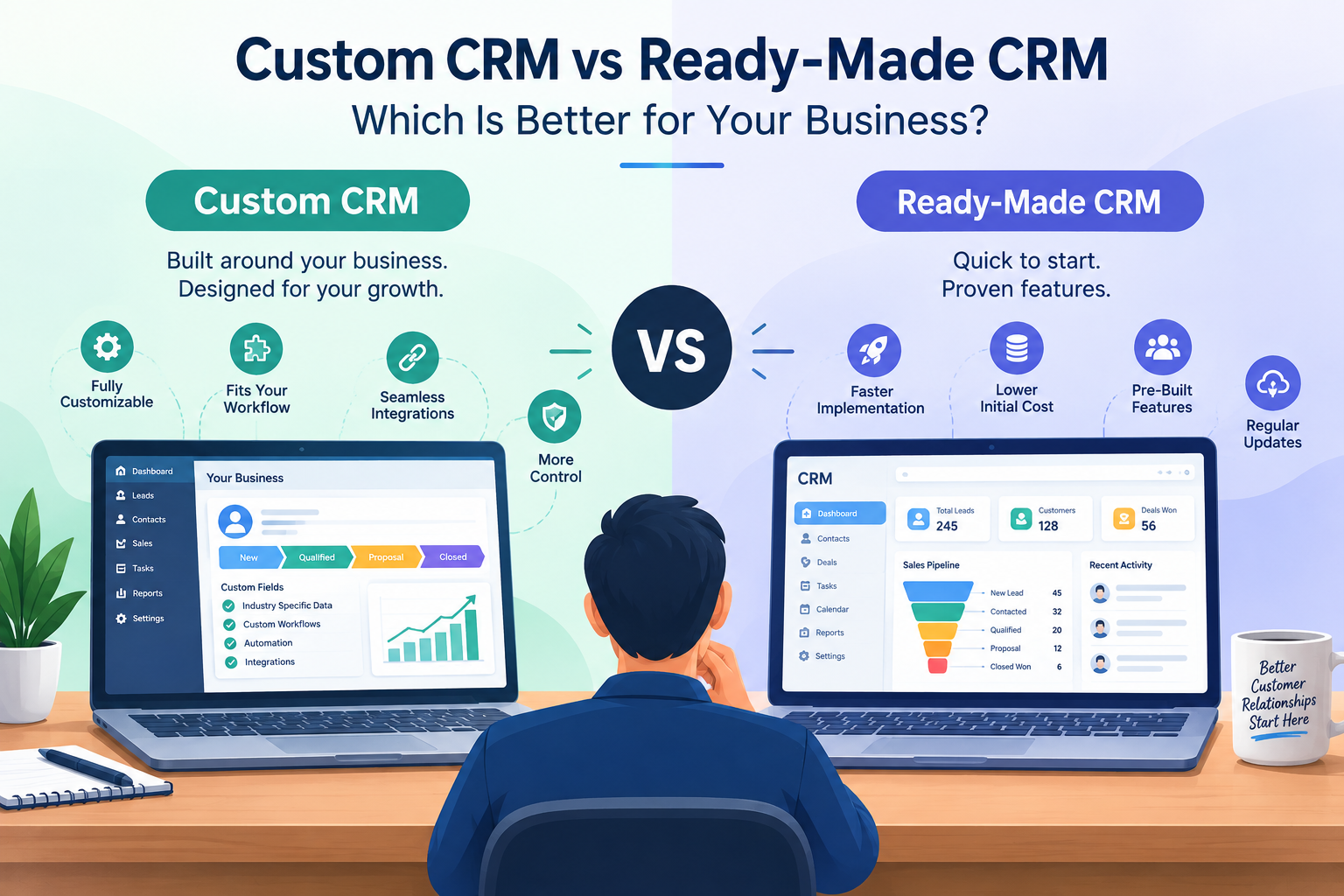
A ready-made CRM is developed for a broad range of businesses and can usually be implemented quickly. A custom CRM, on the other hand, is developed around the specific processes, requirements, and goals of a particular business.
Both options have advantages and limitations. The right choice depends on factors such as your business size, budget, workflow, scalability requirements, integrations, and long-term goals.
In this guide, we will compare custom CRM vs. ready-made CRM and help you understand the key differences before choosing a solution for your business.
Table of Contents
- What Is a Custom CRM?
- What Is a Ready-Made CRM?
- Custom CRM vs Ready-Made CRM: Key Differences
- Advantages of Custom CRM Software
- Advantages of Ready-Made CRM
- Disadvantages of Custom CRM
- Disadvantages of Ready-Made CRM
- Custom CRM vs Ready-Made CRM: Cost Comparison
- Which CRM Is Better for Small Businesses?
- Which CRM Is Better for Growing Businesses?
- How to Choose the Right CRM for Your Business
- Frequently Asked Questions
- Conclusion
What Is a Custom CRM?
A custom CRM is a customer relationship management system developed specifically for the requirements of a particular business.
Instead of changing your business processes to fit existing software, a custom CRM allows the software to be designed around your workflows.
For example, a business may need specific features such as:
- Custom lead management
- Industry-specific customer fields
- Customized sales pipelines
- Automated follow-ups
- Employee performance tracking
- Custom reports and dashboards
- Integration with existing business software
- Role-based access
- Customized notifications
- Automated customer communication
A custom CRM can be developed with the features that are actually relevant to the business.
What Is a Ready-Made CRM?
A ready-made CRM, also called an off-the-shelf CRM, is pre-built CRM software designed to serve multiple businesses.
These platforms generally provide commonly required CRM features such as:
- Lead management
- Contact management
- Sales pipeline management
- Task management
- Email integration
- Reporting
- Customer communication
- Team collaboration
- Mobile access
Since the software is already developed, businesses can usually start using it much faster than a custom CRM.
Ready-made CRM solutions are often suitable for businesses that need standard CRM functionality without investing in software development from scratch.
Custom CRM vs Ready-Made CRM: Key Differences
The biggest difference is flexibility versus speed.
A custom CRM provides greater control over functionality and workflows, while a ready-made CRM generally offers faster implementation and predictable features.
| Feature | Custom CRM | Ready-Made CRM |
|---|---|---|
| Development | Built specifically for your business | Pre-built |
| Customization | Very high | Usually limited to available options |
| Implementation | Takes more time | Faster |
| Initial Cost | Generally higher | Generally lower |
| Scalability | Can be designed around business needs | Depends on provider and plan |
| Integrations | Can be developed as required | Depends on available integrations |
| Maintenance | Business/development team responsibility | Usually handled by provider |
| Features | Business-specific | General-purpose |
| Flexibility | High | Moderate |
| Long-Term Control | Greater | Depends on provider |
Advantages of Custom CRM Software
1. Designed Around Your Business
One of the biggest advantages of custom CRM software is that it can be developed according to your actual business workflow.
You don't have to change your entire process just because a CRM doesn't support it.
2. Greater Customization
A custom CRM can include features that are specific to your industry or organization.
For example, a real estate company may need property management and site-visit tracking, while an educational organization may require student enquiry and admission management.
3. Better Integration Possibilities
Businesses often use multiple systems for accounting, marketing, communication, websites, payment processing, and other operations.
A custom CRM can be developed to integrate with the systems your business already uses.
4. Improved Workflow Automation
Custom CRM development can automate repetitive processes based on your specific workflow.
For example:
New Lead → Lead Assignment → Follow-Up → Sales Discussion → Proposal → Conversion
Automating such processes can reduce manual work and help teams maintain consistent follow-ups.
5. More Control Over Data
With a custom CRM, businesses can define how information is stored, accessed, displayed, and managed.
This can be particularly useful for organizations with specific operational or security requirements.
Advantages of Ready-Made CRM
1. Faster Implementation
One of the main benefits of a ready-made CRM is speed.
Since the software has already been developed, businesses can usually configure the system and start using it much faster.
2. Lower Initial Investment
Ready-made CRM software generally requires less initial investment than developing a CRM from scratch.
This can make it attractive for startups and small businesses working with limited budgets.
3. Pre-Built Features
Most established CRM platforms already include common features such as:
- Contact management
- Lead tracking
- Sales pipelines
- Reporting
- Task management
- Email integration
- Customer communication
Businesses can start using these features without waiting for development.
4. Regular Updates
Many cloud-based CRM providers regularly release updates, security improvements, and new features.
This means businesses don't necessarily need to manage the entire development and maintenance process themselves.
Custom CRM vs Ready-Made CRM: Cost Comparison
Cost is an important factor when choosing CRM software.
A ready-made CRM generally follows a subscription-based pricing model. The business may pay monthly or annually depending on the selected plan and number of users.
A custom CRM usually involves development costs, hosting, maintenance, security, updates, and future improvements.
However, businesses should not compare only the initial price.
It is better to consider the total cost of ownership.
For example:
Total CRM Cost = Initial Cost + Subscription/Maintenance + Integration + Training + Future Development
A ready-made CRM may have a lower starting cost but could become more expensive as the number of users, features, or required integrations increases.
A custom CRM may require a larger initial investment but can provide greater control over the system in the long term.
Disadvantages of Custom CRM
Custom CRM software also comes with certain challenges.
Higher Initial Investment
Development from scratch can require a larger initial budget.
Longer Development Time
Planning, development, testing, deployment, and training can take time.
Maintenance Responsibility
The business needs a reliable development or technical team to manage updates, bugs, security, and improvements.
Requires Proper Planning
Poor requirements planning can result in unnecessary features, higher costs, or development delays.
Disadvantages of Ready-Made CRM
Limited Customization
You may have to adjust your workflow to match the CRM's existing functionality.
Subscription Costs
Monthly or annual subscription fees can increase as the business grows.
Vendor Dependency
Your business may depend on the CRM provider for updates, pricing, features, and technical support.
Integration Limitations
Some platforms may not support every integration your business requires.
Which CRM Is Better for Small Businesses?
For many small businesses, a ready-made CRM can be a practical starting point because it can provide essential CRM features without requiring a large development project.
For example, if your business primarily needs:
- Lead tracking
- Customer database
- Follow-up reminders
- Sales pipeline
- Basic reporting
a ready-made CRM may provide the functionality you need.
However, if your business has a highly specialized workflow, a custom CRM may become more relevant as your operations grow.
Which CRM Is Better for Growing Businesses?
Growing businesses should consider both their current requirements and future plans.
A ready-made CRM may be suitable if the business can operate effectively using standard CRM features.
A custom CRM may be worth considering when the business requires:
- Complex workflows
- Industry-specific functionality
- Multiple system integrations
- Advanced automation
- Custom dashboards
- Specialized user roles
- Greater control over business processes
The goal should be to choose a CRM that supports business growth rather than creating unnecessary complexity.
How to Choose the Right CRM for Your Business
Before selecting a CRM, ask the following questions:
1. What problems do we want the CRM to solve?
Identify your current challenges first.
2. Which features are essential?
Create a list of must-have CRM features instead of selecting software based only on the number of features available.
3. What is our budget?
Consider both initial and long-term costs.
4. How quickly do we need the CRM?
If you need a system immediately, a ready-made solution may be more suitable.
5. Do we need extensive customization?
If your workflow is highly specialized, consider whether a standard CRM can support it.
6. Which integrations are required?
Check whether the CRM can connect with your website, email, marketing platforms, accounting software, payment systems, or other tools.
7. Will the CRM support future growth?
Think beyond today's requirements. Your CRM should be able to support increasing customers, employees, data, and business processes.
Custom CRM vs Ready-Made CRM: Which One Should You Choose?
There is no single CRM solution that works perfectly for every business.
A ready-made CRM may be appropriate when you want faster implementation, standard CRM features, and a lower initial investment.
A custom CRM may be more appropriate when your business requires specialized workflows, extensive customization, unique integrations, or greater control over the system.
The best approach is to first understand your business requirements and then compare available options based on functionality, cost, scalability, integration, security, and long-term requirements.
Frequently Asked Questions
Is a custom CRM better than a ready-made CRM?
Neither option is universally better. The right choice depends on your business requirements, budget, workflow, customization needs, and long-term goals.
Is custom CRM software expensive?
Custom CRM development can have a higher initial cost because the software is developed specifically for the business. The final cost depends on features, integrations, complexity, and development requirements.
Can a ready-made CRM be customized?
Yes. Many ready-made CRM platforms provide configuration and customization options. However, the level of customization depends on the specific platform and subscription plan.
How long does it take to implement a ready-made CRM?
Implementation time varies depending on the CRM, number of users, data migration, configuration, integrations, and training requirements. Basic implementations can generally be completed faster than custom CRM development.
Which CRM is suitable for a startup?
A ready-made CRM can be a practical starting point for startups that need standard CRM functionality and want to control initial costs. A custom solution may become relevant when the startup develops specialized processes.
Can a custom CRM integrate with other software?
Yes. A custom CRM can be designed to integrate with other business applications, depending on the available APIs and technical requirements.
Conclusion
Choosing between a custom CRM vs ready-made CRM depends on what your business actually needs.
Ready-made CRM software can provide a faster and simpler way to manage customer relationships using pre-built features. Custom CRM software provides greater flexibility and allows businesses to build workflows around their specific requirements.
Before making a decision, evaluate your budget, business processes, customization requirements, integrations, scalability, security, and long-term goals.
A CRM should not simply store customer information. It should help your team organize leads, improve follow-ups, manage customer relationships, and create a more efficient sales process.
Choose the CRM approach that fits your business—not simply the one with the longest feature list.


Post a Review